Over the years I have abandoned most of the books in my library. At least three thousand of them have left my shelves and are now in the hands of a distant bookseller. I do not miss them. While they once carried some importance to me, I can no longer remember most of their titles. As for the two thousand or so books that remain, I have no plans to get rid of them, but I know that most are likely to remain on their shelves, never to be read again by me. They do not know what I know: time is short. Now that I’m in my late eighties, it’s difficult for me to recall when, where, or why I purchased all these books, or who gave them to me, or how I once taught them to students, whose names I’ve also forgotten.
I taught British and American literature for more than fifty years. The books I taught in those courses are the ones for which I had the greatest affection and so they come first in memory and attention. A few of my surviving books appeared to me before I taught and are staying on because they mark turning points in my life. One of them is the first serious book I ever read: Moby Dick. At the time, I understood only the adventure and missed Melville’s dark psychology and metaphysics. The next serious book I read—and then, spellbound, immediately reread—is Robert Penn Warren’s All the King’s Men. It drew me into a claustrophobic world of power, fear, and political lust. Those two books will never go to the bookseller. Nor will three others—D. H. Lawrence’s Sons and Lovers, James Joyce’s A Portrait of the Artist as a Young Man, and J. D. Salinger’s The Catcher in the Rye. In their description of adolescent pain, these books give me back my preposterous youth and will remain on the shelves for that reason. As for a book to mark the settled sobriety of my advanced years, I keep Boswell’s Life of Johnson close by. Its praise of steady judgment, as well as its moral force, make it a reassuring survivor.
Also surviving is all of Shakespeare, a well-worn anthology of English and Americanpoetry, and the thirty-two volumes of the eleventh edition of the Encyclopedia Britannica. To jettison these books would be to jettison what they have represented to me: the best of wisdom, the best of language, and the best ways to preserve and organize knowledge. When it comes to history, my learning has been scattershot. But I recall the powerful impact that Norman Cohn’s Warrant for Genocide, Jean-Denis Bredin’s The Affair: The Case of Alfred Dreyfus, and Tony Judt’s Postwar: A History of Europe Since 1945 all had on my thinking about where I stood, as a present-day American, with respect to some of the cataclysms of the recent past. Those books will remain with me as examples of how to write about that past with power, clarity, and conviction.
As for all the other books, why keep them? Because some were written by friends or colleagues, now dead; their knowledge and intelligence must be honored. Out of another kind of piety, I am keeping books inscribed and given to me. And a special space is being held for those books that, in their sheer monumentality, have represented to me intellectual or artistic achievement of the highest order: Dante’s Divine Comedy, Joyce’s Ulysses, George Eliot’s Middlemarch, Flaubert’s Madame Bovary, and most of Henry James, Proust, Dickens, and Faulkner. And the word magic of some of the great poets—of Donne, Herrick, Keats, Yeats, and Heaney—will remain a pleasure and a consolation for as long as I can read.
Still, many of the remaining books don’t fall into any of these categories. Why keep those? Vanity is part of the reason; a lack of vanity, the other part. They will remain because they remind me, and will remind those who come after me, that I was once a constant reader and was awed by the ways books could fill my mind and enrich my days with meaning. At the same time, as a constant reader much of my life has been spent in the minds of other people, and to them and their immense achievements I have been pleased, again and again, to surrender. From them, I have learned much, but not all, of what I know. Some of my old books remind me, with the shock of recognition, that when I read them, I had been lifted, however briefly, out of the narrow limits of the familiar and the shallow confines of my self, out of all my mental routines and into a more radiant world I would never have known otherwise.
Because some books convey enormous strength, I subscribe to the notion that “a real book reads us.” Among my surviving books, then, will be a very few whose interrogating power is not to be found anywhere else. Their authors tell me that I have never known myself well and still haven’t dug deep enough to see what I’m truly made of. One of those authors plants me amid existential horror, another makes me recoil from the modern world, and a third brings me close to authentic evil. For these special reasons a special section of my shelves has been reserved for the seductive works of Franz Kafka, Evelyn Waugh, and Flannery O’Connor.
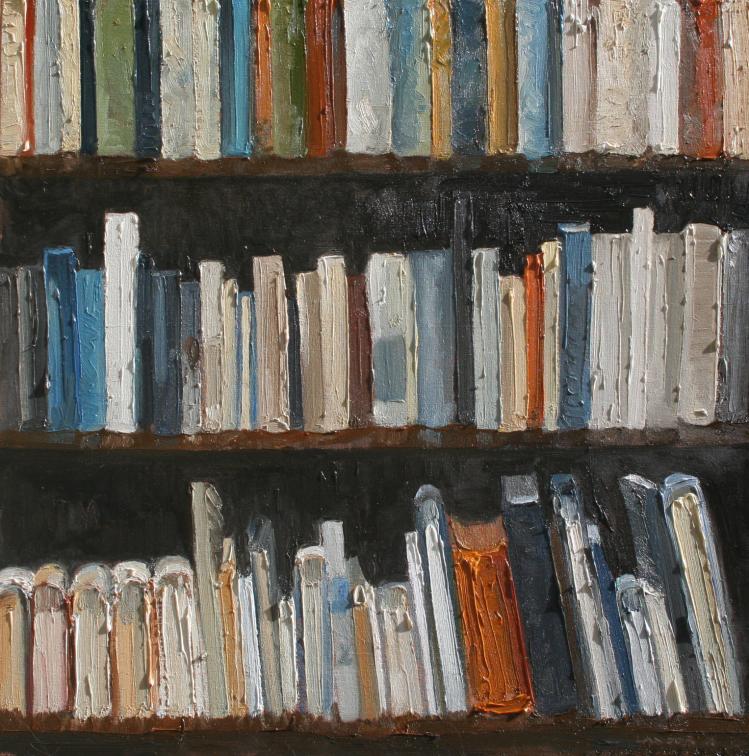
Other books remain because of their reality as objects. They are reminders of the bookmaker’s craft. Their spines and jackets, their colors and dimensions, the way they can be hefted and handled—all bespeak a formidable ingenuity of effort now dying away. The conversion of print and pages into pixels and screens gives us personal libraries that will be carried about in thumb drives and external storage devices. As that relentless process goes on, books that once occupied space, as bodies do, will be rendered bodiless. But my own books, in their many rows, will stay in my library as a sturdy display of art and knowledge. They will be recognized and appreciated for what they are: examples of a supremely useful tool that is moving toward obsolescence. But for now they are still with me, and they will survive me. May future readers find in their own books at least some of the power and pleasure I have found in mine.
We welcome your comments about this article. Please send your response to [email protected].